
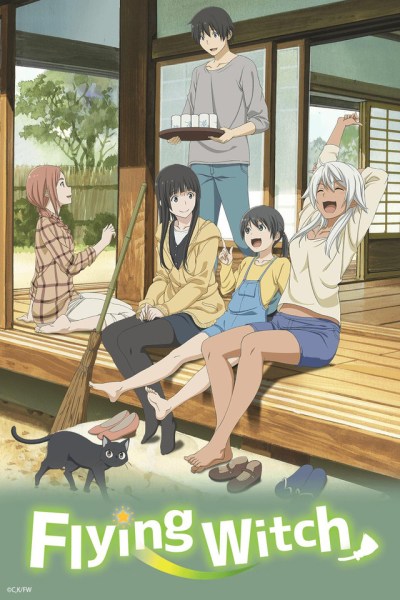
Flying Witch (ふらいんぐうぃっち)
(Anime 2016)
Studio: J.C. Staff
Created By Chihiro Ishizuka
When I first heard about this anime, it came from a review from a fellow blogger. He described it as a “healing” anime, which is a term I never associated with an anime until now. “Healing” anime is a sub-genre that I would like to watch more of in the future, so if you have any anime recommendations let me know!
Flying Witch is about the daily adventures of a young witch, Makoto, who moves to her relatives’ home in Hirosaki, Aomori as part of her witch training. Makoto learns to adapt to country life and teaches her friends and family about witchcraft.
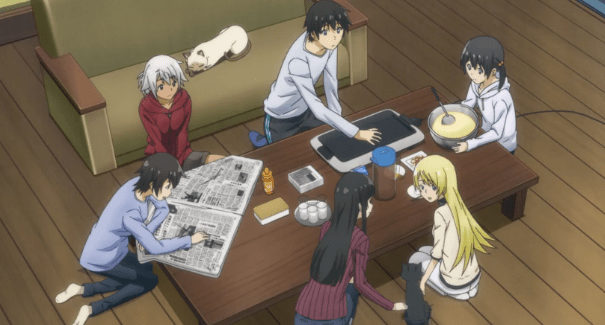
I really enjoyed watching Flying Witch and I can see the comparisons to Kiki’s Delivery Service. The overall tone of the anime was set right in the beginning—heartwarming. However, what makes this anime a bit unique is how they take the fantastical and make it an everyday thing. The anime does a great job in making the extraordinary into the ordinary and I will be discussing some of these observations and others in this post.
Witty Punchlines
Flying Witch‘s episodes are episodic. In every episode, the characters go through their daily activities with a minor problem that they resolved by the end. The jokes within each episode are witty as they usually involve a subtle punchline or a surprise kicker at the end that puts a smile on the viewer’s face. For example, when Inukai transforms into a dog after drinking sake, she blames her witch friend, Akane for it, but it turns out that Inukai brought this upon herself.
The Magic Of Ordinary

Flying Witch is a fantasy anime, but it takes the fantasy and makes it an everyday norm. An example of the everydayness of magic is when the group visits a cafe for spirits and supernatural beings. These supernatural beings are anthropomorphic as they seem like humans going to a cafe. The cafe can only be seen by spiritual creatures though, but Makoto’s cousins, Kei and Chinatsu, are able to enter this magical cafe because they are believers of magic.
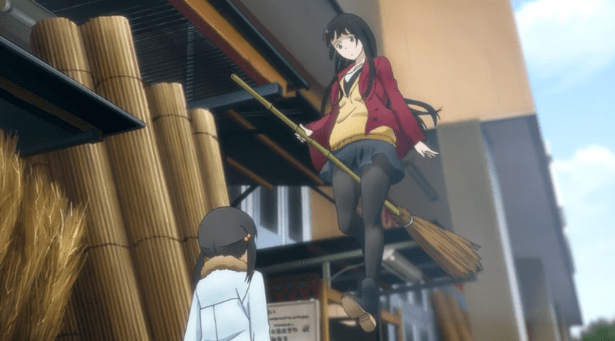
Yet, Makoto’s cousin, Kei Kuramoto, is not phased by magic. Whenever Makoto does magic like flying or making potions, he doesn’t seem amazed by it, but rather treats magic as something he sees all the time. In fact, it seems as if once you become an adult, your imagination and creativity are at a loss to some extent. Yet when you’re young, you believe in magic wholeheartedly and your imagination runs wild. Kei’s little sister, Chinatsu, admires Makoto once she learns that she is a witch, and she then hopes to become a witch as well.
Grotesqueness Isn’t Scary

The art in Flying Witch was gentle and heartwarming. Yet there are scenes where this feeling of warmth is combined with some grotesqueness. One disturbing image is the mandrake root—the way that the mandrake is drawn is somewhat scary. Yet, despite its outward appearance, Makoto states that the root is harmless and shall be used for medicine which allows viewers to trust Makoto and to view the mandrake in a different light.
Small Person In A Big World

Lastly, I really enjoyed the use of landscape perspective in this series. There were certain scenes where the characters were “small” in comparison to nature. This type of perspective conveys the importance of exploration and discovery with nature. It gives a sense of appreciation towards life and the world surrounding a person. This perspective represents Makoto as she is a young witch in training and she has a long journey ahead of her.
I would describe Flying Witch as a chill anime to watch when you don’t want to think too much about content. It is light-hearted and fun. 🙂
You can watch the series on Crunchyroll.
5/5



 Just Something About LynLyn
Leave a reply to Pop Culture Literary Cancel reply