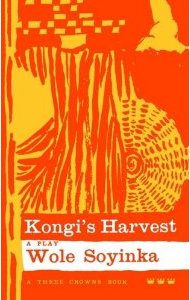

Kongi’s Harvest (1965)
By Wole Soyinka
Kongi’s Harvest is a dramatic African play written by Wole Soyinka. Soyinka won the Nobel Peace Prize for Literature in 1986. Soyinka writes political satire, where he addresses the current evils of politics run by dictatorship and selfish gains in Africa.
In Kongi’s Harvest, the land of Isma is ruled by Kongi. Kongi has sent his enemies to detention camps. In hopes of becoming not only the political leader but also the spiritual leader, Kongi demands that Oba Danlola hands him the New Yam harvest during the festival. This act will symbolize complete submission of the lands and people of Isma. However, Daodu—the son of Sarumi and the heir to Danlola’s throne—and Segi—the former mistress of Kongi and now Daodu’s current lover—plan to assassinate Kongi. The plan fails and Segi’s father was killed instead.
This play is a political satire. Soyinka shows the tyranny and dictatorship behind Kongi’s intentions through Kongi’s demanding attitude about the festival and tyrannical nature towards others. Although it may seem that Kongi wants to incorporate the traditions of Isma when Danlola ruled such as their language and clothing, Kongi is only doing so to gain the complete submission of the people and become the authoritative figure in politics and spiritual upbringing. He tries to “save face” by showing his desire to unite all the people. In fact, his desire for harmony is shown when he agrees to a bargain: the New Yam handed down by Danlola in exchange for the reprieve of five prisoners. Yet, the agreement fails when one of the prisoners escaped and so, Kongi declares that he wants that escapee alive if possible or dead. The breaking of negotiations shows Kongi’s true colors. Despite his emphasis on harmony, he cares more about his power as opposed to the lives of the people and democracy.
The two symbols that are important in this play is the harvest yam and the drum. The harvest yam is seen as a peace treaty and the symbol of new beginnings. The harvest festival is being held to show the passing of power through the act of giving the yam from the former leader to the new leader. As for the drum, the drum is a representation of traditional values and beliefs, particularly in Yoruba culture. There are various scenes where Danlola and his people dance but get interrupted by the stopping of the drum. I would consider the abrupt stoppage to symbolize the obstruction of Danlola’s power and traditional culture.
I wasn’t really fond of this play. Much of the action is focused on political strategies of overthrowing Kongi or Danlola. My issue is that the language doesn’t explicitly convey these political strategies, instead, it’s implied through African proverbs, culture, and literary references. Thus, I had a difficult time grasping the plot. Furthermore, the play is meant to be performed as opposed to being read, which may be part of the issue of why I didn’t enjoy this play as much.
2/5




 Just Something About LynLyn
Leave a reply to Pinkie Cancel reply