
Lately, my sister and I have been binge watching some anime and it just so happens the two that we watched were Usagi Drop and Barakamon. I decided to group these two anime together because they both deal with irresponsible adults taking care of children.
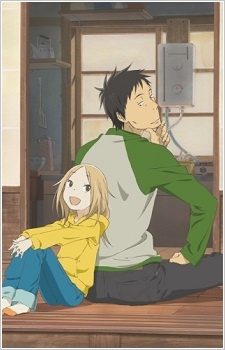
Usagi Drop (うさぎドロップ)
(Anime 2011)
Studio: Production I.G.
Created By: Yumi Unita
Daikichi Kawachi is a single 30-year-old workaholic who doesn’t know how to take care of himself. Yet when his grandfather passed away, he learns that his grandfather was secretly taking care of a child, Rin Kaga, who happened to be his grandfather’s illegitimate child. Rather than sending her to an orphanage, Daikichi takes it upon himself to be her guardian, and he learns the ups and downs of parenting.

Episode one got my sister and I hooked to this show. In fact, we felt that this anime didn’t need an actually series because the first episode had a satisfying ending already. Yet each episode continued to be adorable and brought tears to our eyes. In the anime, I was rooting for those two to become a real family with the Nitani family (I do know though that this doesn’t happen in the manga). During the typhoon episode, the two families “played house” by making and eating dinner together. They have a well-balanced relationship between each other. Yukari acts as a mother figure towards Rin, and Daikichi could be seen as a father figure for Kouki. For example, when Rin gets sick, Yukari immediately takes care of her by making porridge for her and checking in on her to make sure she’s okay. Also, Daikichi knows the mindset of Kouki so he can easily relate to him since he acted like that when he was a kid.
In the anime series, it is clearly established that Daikichi and Rin’s relationship isn’t a parent-child one because Rin refuses to take Daikichi’s last name when enrolling into school. In addition, Daikichi made sure that he isn’t addressed as Rin’s father among friends, family, and other people that they encounter. I didn’t understand why a parent-child relationship was not establish in the beginning of the anime, but later on, when I read the spoilers for the manga, I understood the why. When Rin is older, she realizes that she has feelings for Daikichi and they eventually become a couple. It would be morally wrong if the two had a romantic relationship when they already established a father-daughter relationship. However, it is clearly defined in the anime that Rin’s father is only Daikichi’s grandpa.

So I only watched the anime, and I don’t intend to read the manga because my interpretation of Rin and Daikichi is a guardian-child relationship; thus, I can’t see it as anything else but that. My view of their relationship is shaped by only seeing the anime, and it seems that the anime conveys the relationship as just a paternal one. Personally, I find it off-putting that Rin would have feelings for Daikichi because he treated her as a daughter and his love is shown through parental care. Hence, I can’t unseen this type of relationship between them, and that is why I won’t read the manga.
5/5

Barakamon (ばらかもん)
(Anime 2014)
Studio: Kinema Citrus
Created By: Satsuki Yoshino
Barakamon doesn’t have a parent-child relationship to it, but it does have an adult dealing with youngsters around the neighborhood. Seishuu Handa is a talented up-and-coming calligrapher. However, during a competition, an expert labeled his work as “unoriginal textbook-like” writing, and as a result, Seishuu punched him. As for punishment, Seishuu’s father sends him to Goto Islands in order to self-reflect on his wrongdoings and to also give Seishuu some peace of mind. While living on the island, he befriends some of the local children, and by joining their antics, Seishuu is able to find inspiration for his work.
Although not explicitly raising kids, Seishuu could be seen as a role model for the youngsters. Yet a majority of the time, it seems like the children are teaching Seishuu how to be more mature rather than the other way around. One such character that brings the fun and lightheartedness to Seishuu is Naru Kotoishi, a cheerful hyperactive six-year-old who doesn’t listen to Seishuu most of the time and would get in trouble. In fact, it is Naru and some of the other kids that inspire Seishuu’s calligraphy.

While on the island, Seishuu realizes what his art style is missing: passion and inspiration. As I mentioned before, the critic claimed that Seishuu’s work is too generic. Although it’s good to learn and master the fundamentals, Seishuu has yet to make his own calligraphy style. Yet while on the island, Seishuu gains all these new experiences that he wouldn’t have received while living in the city. For instance, he spent his time hanging out with the locals by watching over Naru’s grandmother’s grave during the Obon Festival, and he also tried to capture mochi during the mochi-throwing gathering. It’s the little things that make Seishuu realize how important it is to interact with others—you build strong friendships and create memories together. The island not only inspired him to write calligraphy, but it also allowed him to grow and mature as a man.

There’s a reason why I recommend Barakamon to people, and it’s mainly because Seishuu Handa is someone we can all relate to especially young adults starting out their careers. Although we are aware that Seishuu is a natural talent in the world of calligraphy, we are able to see his failures in the profession, which makes him somewhat human or in other words, relatable to the audience. In the anime, we see how resilient Seishuu is as he tries to rebuild his good reputation with the public (even though at times, he sulks when comparing himself to other people). I think Seishuu is a character that young college graduates should be able to relate to because, through his struggles, one can find strength and confidence to pursue personal career goals.
The two girls, Rin and Naru, are so innocent and naive: they aren’t fully exposed or able to comprehend the harsh realities of adulthood. Yet, they give support to the adult figures that they care about, they remind them of what’s important in life, and they allow them to develop into mature and responsible adults (…or try to).
5/5




Leave a Reply