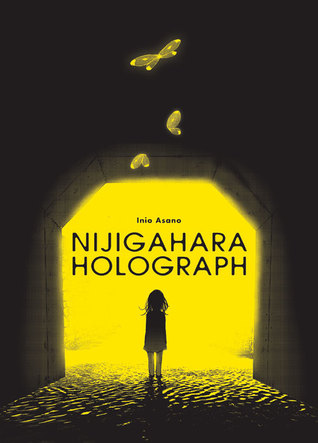
Nijigahara Holograph (虹ヶ原ホログラフ)
(Published in 2006, Translation in 2014)
By Inio Asano
Translated By Matt Thorn
Nijigahara Holograph is about a group of kids living in a town that is haunted by a rumor. There is said to be a monster that resides in the river tunnel and to appease this monster, the children made human sacrifices. The story is told in two separate timelines; in which the students and adults must confront the sins they have committed in the past.
As I mentioned above, this story is set in two different timelines: the past (when the characters are children) and in the present (when those children are now adults). In the past, these children bullied and tormented their fellow classmates. Thus, we are able to see how the past influences these children’s future. For example, the troublesome bully, Kohta, violently hurt and bullied his classmates and friends which result in him committing murder such as the store manager he worked with when he is older. His acting out seems to be because of the girl he likes, Arie, who’s in a coma state after his fellow classmates bullied her to death. His violent actions is a coping mechanism for him but it also seems that he lost the will to live after losing someone he cares about dearly. Kohta is just one example of how the “present” is reflected by the past.
Not only do the children form bad habits but the adults also make poor decisions and mistakes. When Arie suffered, her teacher, Miss Sakaki, turned the other cheek and ignored that her students were bullying one another. She regretted it later on as she felt guilty and responsible for the well-being of Arie, and so when Amahiko faced some issues with bullying and suicidal thoughts, Miss Sakaki tried her best to appease the situation and be a positive support for him.
The story is presented to readers in two different timelines in order to present how the past influence a character’s way of thinking and the choices he or she makes. If one doesn’t develop good habits and make moral decisions as a child, they may end up having a difficult time being a good adult. It is to say that the root of criminal behavior is from a child’s development—how a child grew up and the people he or she is surrounded by. I think this is the main message that Inio Asano is conveying in this manga through the two storylines.
Another interesting aspect of this manga is the butterfly symbol. Every chapter there seems to be a character that sees or is engulfed in butterflies. This usually happens when someone dies or commits an act of murder as well as when a person succumbs to fear and anxiety. I think the butterflies are in reference to the concept of “the butterfly effect” because the past actions of the students and adults have a negative impact on their futures.
Overall, Nijigahara Holograph is a psychological thriller and the premise is fascinating. However, there are some gaping flaws in the storyline. This manga is rather experimental in its use of storytelling as we are given two different storylines that are somehow connected to one another. There’s a connection between both the past and present but how the author ties it all together is very loose. There are some lingering questions a reader will have at the end. One question I had was, “What’s the purpose of this story?” The reason as to why I have this question is due to the fact that readers aren’t given a satisfying conclusion nor any real substance as to what the main plotline is in the beginning (readers are left to guess).
This manga is a great read for people that are interested in abstract plots and who like to contemplate on these existential questions. I would describe this manga as experimentally odd and seriously traumatizing.
3.5/5



 Just Something About LynLyn
Leave a comment